
Blog
What’s SaaS Hosting? Definition & Best Hosting Providers

Sep
Software-as-a-Service hosting is a form of website hosting that permits customers to access your software app or platform via the Web. Just like SaaS as a software delivery method, SaaS hosting leverages the cloud to store your app and the related files in your hosting provider’s server – giving customers easy accessibility to what they need once they need it.
Understanding what SaaS hosting is and the way it pertains to your offerings as a software provider could open your enterprise as much as latest levels of growth. To enable you to make the most of this untapped resource, Liquid Web is here to give you this in-depth guide to SaaS hosting.
Advantages of Partnering with SaaS Hosting Providers
As cloud technology has grown, the SaaS model has come to influence greater than just software. Software providers may even purchase their hosting – the backbone of their software platform – on a SaaS basis.
SaaS hosting is rapidly replacing the normal physical, on-site data center model. While that’s certainly one of the fundamental advantages of this hosting structure, there are a lot of more benefits to using a virtual data center.
Let’s have a look at several reasons it is best to consider SaaS hosting below.
1. Speed
Considered one of the fundamental advantages of leveraging SaaS hosting on your software platform is how quickly you’ll be able to reach your customers. Legacy, single-tenancy software used to require a physical boot device like a CD-ROM. Applications would take days or even weeks to get into your customers’ hands. Users would experience much more downtime while waiting for the software to be installed. And if the pc they wanted to make use of doesn’t have adequate resources? Well, that was an issue that might take even longer to repair.
SaaS hosting lets you avoid those pitfalls. When a brand new customer opts to make use of your software, your hosting provider just has to partition their virtual servers to create one other instance of the software. In lower than an hour, your newest user is up and running – benefiting from all of the functions and features your software has to supply.
2. Scalability
Hosting your software application on a managed private cloud affords you access to more server resources. As an alternative of being confined to the finite resources or hardware in a dedicated server, your SaaS hosting provider can shift more resources to your infrastructure as you grow.
As more users enroll on your software, your hosting provider can simply partition you more resources to handle the expansion. Moreover, the financial investment related to growing and reconfiguring servers is put onto your hosting provider and isn’t any longer your internal responsibility which, in turn, lowers costs much more since less IT staff is required. The staffing resources you’ve is also used for more complex, helpful IT tasks.
3. Backup and Disaster Recovery (BDR) Procedures
The largest concern for IT professionals, generally, is the lack of necessary files or information. Backup instances of necessary files and programs are needed, but can often take up large amounts of server resources. Leveraging the form of virtualization SaaS hosting provides helps keep your necessary information secure while freeing up your internal system for more necessary applications. At Liquid Web, customers can depend on Acronis Cyber Backups to store critical files offsite and off server.
Because you’re coping with a hosting provider liable for all their clients’ data, you’ll be able to make certain they keep a strong catalog of backups in place. Naturally, you’ll wish to ask your provider about their standard backup procedures and ensure they align with your enterprise goals before signing an agreement.
Secondly, SaaS hosting within the cloud will enable you to avoid natural disasters. Physical data centers are hard to maneuver. If a weather event is headed toward your facility, it could be too late to guard your essential servers and files. Making the most of the cloud lets you store sensitive information 1000’s of miles away out of your physical location – keeping the information that keeps your enterprise going out of harm’s way.
4 Examples of SaaS Hosting Providers
To raised understand how what SaaS hosting is strictly, and the way it could further your enterprise, it’s helpful to see who a number of the leading real-world SaaS hosting providers are and the way they fit into the general SaaS landscape. Listed below are some examples.
Nexcess StoreBuilder
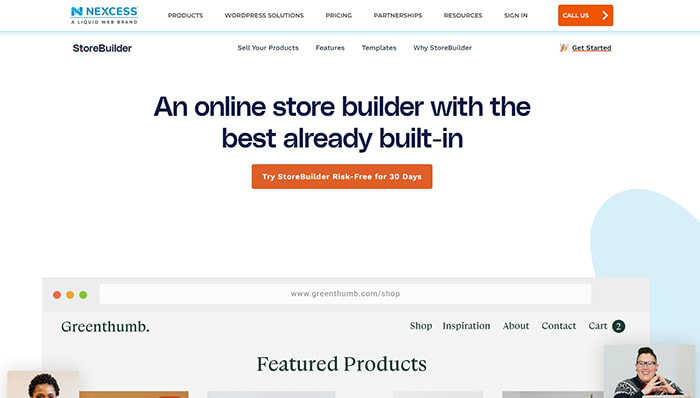
With the eCommerce industry growing as fast because it is, latest business owners within the space are consistently searching for ways to get their stores up and running as quickly as possible. And for those aware of WordPress, how do you navigate the plethora of theme and plugin options, not to say customization?
This is strictly why Nexcess StoreBuilder, a part of the Liquid Web Family of Brands, is such a well-liked application. Users can implement intuitive design features right into their store, depend on live expert support, and still maintain total control over their eCommerce business, all inside a sleek, easy-to-use framework.
Pros
- No coding is required.
- Fully custom templates.
- Built-in sales monitoring.
Cons
- Intake questions are required for the very best experience.
- Is probably not ideal for everybody.
Amazon Web Services (AWS): Pros and Cons
AWS is Amazon’s solution for business owners who wish to leverage cloud hosting and for his or her SaaS applications. With a big suite of individual apps, AWS has grow to be a very talked-about web-based solution for businesses wanting to modernize their offerings. But small- to medium-sized businesses (SMBs) and independent software vendors (ISVs) may find it difficult to move to the cloud with major cloud service providers corresponding to AWS.
Pros
- Customizable pricing.
- Sophisticated framework.
- Strong security.
Cons
- Only a few AWS-skilled professionals.
- A big number of consumers results in quite a few general issues.
- 24/7 support could make operating costs extremely high.
- No management is included as in comparison with a managed private cloud.
DigitalOcean: Pros and Cons
Image Source: DigitalOcean
DigitalOcean offers cloud services to support a wide range of uses. Users can construct API backends or web apps, and so they can integrate their projects with popular platforms like Kubernetes. Customers can learn the fundamentals of cloud computing, in addition to make the most of the advantages below. But for those trying to move their apps to a supported and stable console, it may not be the very best solution.
Pros
- Easy-to-use interface.
- Low entry price.
- Lower overall cost in comparison with other products since the platform is unmanaged.
Cons
- Lack of live support.
- Subpar console support and stability.
- Must pay for backup droplets.
Cloudflare
Cloudflare supports your latest SaaS project by ensuring it stays secure, fast, reliable, and personal. Their cloud hosting is backed by certainly one of the fastest global networks designed to deliver first-class reliability, security, and performance. Liquid Web is a proud partner of Cloudflare, and we provide Cloudflare plans to our users as an added bonus.
Pros
- Several different products for SaaS users.
- User-friendly interface.
- Free plan offers robust features in comparison with competitors.
Cons
- Free version is slow. Can take as much as 24 hours to import data.
- Advanced safety features only available on paid plans.
- No live support available.
4 Suggestions for Selecting SaaS Hosting
Although the businesses above have their drawbacks, they represent a number of the most distinguished names within the SaaS hosting space. Nonetheless, there are a lot of more options available.
Before shopping, listed below are some key features to think about when selecting an infrastructure provider to host your SaaS or software:
1. Assess Your Business Needs
Each SaaS application is different. You’ll need to think about which individual resources your SaaS or software will depend on most. Hosting providers can provide a big selection of features. Consider which features your team can handle in-house and which make sense to dump onto a third-party provider.
Your budget can also be going to be a very important consideration. The features offered by hosting providers cover a broad spectrum. By taking a deeper look into which features are most vital to your enterprise, you’ll have the ability to search out the proper balance of features offered and the value points available.
2. Plan With the Future in Mind
Your SaaS resources might want to grow together with your enterprise. Whichever hosting provider you select must have options so that you can upgrade your account to extend the resources they make available to you and enhance your enterprise’s scalability. It’s also crucial for you to examine and ensure these upgrades can be found at an inexpensive pricing structure.
The SaaS provider’s technology features will play a very important role as well. It’s necessary to think about the technology your provider offers at every stage, but when planning for future growth, you’ll wish to deal with technology you think that you’ll need 12 months from now. Does the provider you’re currently considering support those technologies? If not, they might not be the very best overall solution on your SaaS platform.
3. Consider Security
With the entire global businesses using cloud technology to power their offerings, within the software business and beyond, digital threat actors have began to take notice. Large, complex data networks lead to greater exposure to vulnerabilities and create a veritable digital playground for the hackers of the day.
When purchasing for a SaaS hosting provider, you’ll need to decide on one with the right security protections for your enterprise. Consider the industry you’re serving and the form of information your customers may have to store when using your SaaS platform. Certain industries must adhere to strict regulatory compliance in terms of data management.
When weighing a possible provider’s security options, listed below are the features it is best to consider:
- Malware scanning.
- Network monitoring.
- Firewall.
- DDoS attack protection.
- Server and system hardening.
- Phishing protection.
- SFTP.
- Spam filter.
- User authorization.
- Certifications (i.e., HIPAA, SSL, PCI, TLS).
Along with your SaaS app’s unique needs, you’ll also need to think about your overall security goals. Taking the above features and functions into consideration will enable you to select a SaaS hosting partner that will be trusted throughout the lifetime of your enterprise.
4. Understand Your SLA
When you’ve found the Software-as-a-Service hosting company that’s best for you, it’s time to make your partnership official. Normally, this is completed through a service level agreement (SLA).
The role of the SLA is to set the expectations for each parties, the way you’re expected to act as a customer and the way they’re expected to act as a vendor. The service level agreement may also outline necessary details like what shall be used to measure performance and what happens within the event of a service disruption.
Listed below are just a few key items you’ll wish to search for in your hosting provider’s SLA:
- Uptime Guarantee: A good hosting provider should have the ability to ensure five nines of uptime (99.999%). Any downtime you experience means customers can’t access their necessary files and data. Look for optimum uptime.
- Easy Termination: It is best to have the ability to terminate the agreement quickly and simply, without retaliation from the provider, within the event of SLA non-compliance.
- Reporting: The SLA should clearly state that your hosting provider is liable for delivering performance reports, in addition to how often they’re to be delivered.
- Penalties: Be sure that your service level agreement details what happens within the event of downtime or service failures. There needs to be a transparent path for compensation or service credits for any significant service disruptions.
To search out all these qualities and more in a Software-as-a-Service hosting provider, you’ll should work with probably the most reputable names within the business. Reach out to our team of the Most Helpful Humans in Hosting here at Liquid Web.
We are able to enable you to navigate our first-class IaaS offerings to host your software to search out the very best solution for your enterprise.
How Liquid Web Helps SaaS Brands
Should you’re considering SaaS hosting, you’ll want to select a partner that helps you jump the educational curve. You’ll also want someone in your side who can enable you to easily transition to SaaS without requiring any major business changes or code rewrites. That’s where Liquid Web is available in.
Having Liquid Web’s Private Cloud in your side is a gamechanger when leveraging cloud technology. Helping you transition easily without latest coding is on the core of what VMware is. When you see how easily we will have your software app up and running on our managed cloud, you’ll understand why you wish VMware to make the switch to the cloud. Our expert team may enable you to with complex concepts surrounding our progressive technologies like what Storage VMotion is, and the way it could enable you to maximize uptime while transitioning your data.
With many years within the hosting industry, and experience using the most recent in Software-as-a-Service hosting and server technology, Liquid Web has the infrastructure you’ll want to compete in the trendy SaaS landscape.
Contact us today and discover why we’re the proper partner to enable you to accomplish all of your enterprise goals.

