
Blog
Planting caladiums at home with this step-by-step guide
Jul
That is an important time of the yr to fill every space in your own home with color. Are you moving into gardening? Then how about planting caladiums in your own home?
This tropical plant with large, showy foliage might be an important addition. Plus, it’s easy to look after and doesn’t require numerous space.
In this text we’ll inform you about caladiums and, along with learning about their varieties, we’ll show you tips on how to plant them!
General characteristics of caladiums
Caladiums are herbaceous plants with tubers that belong to the family Araceae. They’re native to the tropics of South America and were introduced to Europe within the mid-18th century.
Since that point, they’ve turn out to be a well-liked indoor and outdoor species because of their easy care. Although they’ll grow as much as 1.5 meters (nearly 5 feet) tall, on average they typically reach around 30 centimeters (1 foot).
Some of the striking features of caladiums is the density of their foliage. Their leaves can reach a size of about 15 centimeters (6 inches) wide and 45 centimeters long (18 inches).
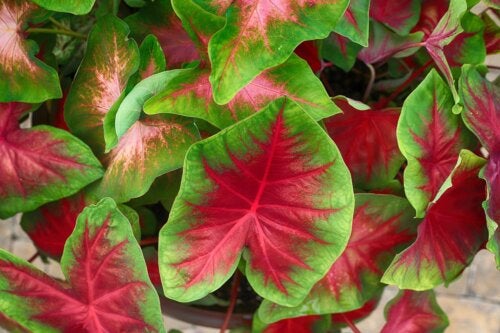
Additionally they have quite a lot of shapes and colours. From white to green, red, pink, and orange with speckles or veins. They add a touch of vibrancy to any garden.
Caladium species you may plant in your own home
In line with a publication from Floriculture and Ornamental Biotechnology, the exact variety of caladium species remains to be a matter of debate, various from 7 to 17 depending on which classification is consulted.
Listed below are a number of the hottest and well-known in gardening:
- Caladium bicolor: this number of caladium is probably the most common and has undergone genetic improvements to create hybrids. Its foliage is generally green, adorned with red or white veins, while its spathes might be yellow or white.
- Caladium hortulanum: the leaves of this species are unique, as their texture resembles that of paper.
- Caladium humboldtii: this sort has small leaves with green tones, which present a pattern of spots or white marbling of assorted configurations and dimensions.
- Caladium picturatum : this sort has elongated leaves with white veins.
- Caladium steudneri folium: although less popular than other varieties, it has glossy green leaves, evenly marbled in white, that are waxy and resemble the form of a heart.
Discover more with this fascinating article: Spring is Here! Plant These 8 Bulbs in Your Garden to Fill it with Life and Color
Planting caladiums at home
The cultivation of caladiums can occur in two ways:
- Multiplication by tubers
- Sowing seeds
Read on for a step-by-step guide on planting caladiums at home! Then you definately can enjoy their beautiful large and showy leaves.
1. Multiplication by tubers
To plant caladiums at home you can plant the entire tuber or divide it into several parts, ensuring that certainly one of them has a minimum of two buds. Before planting, it’s advisable to treat the cut areas with a broad-spectrum fungicide containing sulfur. Then allow them to dry for one or two days.
Bury them at a depth of two to three cm (around an inch) in a pot or within the garden. During this stage, try to not water them continuously and keep them at a temperature of 20 to 27 °C (68 to 80 F) until the fourth leaf sprouts.
Later, you may transplant them to a bigger pot and use a substrate wealthy in organic matter with a little bit sand. In this manner, you’ll facilitate water drainage. From that moment on, watering ought to be regular.
2. Sowing seeds
In the event you resolve to multiply the caladiums by seed, it’s advisable to attend for the arrival of a temperate climate, ensuring that the ambient temperature doesn’t exceed 20 °C (68 F). For this process, you’ll only need to arrange a tray with a light-weight, sandy substrate.
There you’ll bury the seeds, covering them evenly, to make sure humidity in the course of the germination period. It is important to maintain them in low light and with the substrate at all times humid, at a temperature between 20 and 23 °C (68 to 73 F).
In case of strong winds, the perfect thing is to cover the tray with glass or plastic. Periodically, remove the quilt to avoid excess humidity.
Once the seeds germinate, remove the plastic or glass and increase the quantity of sunshine that reaches them. Make certain they’re kept out of direct sunlight and receive good ventilation.
In the event you detect weak seedlings, remove them to provide the sturdy ones more room to develop. Then, once they have some leaves, transplant them into small pots, being careful not to wreck their roots.
The primary leaves will likely be all green, as the colour of the range begins to indicate from the sixth or seventh leaf.
Don’t miss this text especially chosen for you: 11 Purple Flowers to Make Your Garden Look Elegant
Be careful for pests!
When growing and planting caladiums, it is important to concentrate to them, with a view to avoid pests and diseases. Aphids and spider mites are a number of the commonest. They could cause serious damage to the leaves.
To forestall them, you need to control humidity and the quantity of sun they receive, in addition to maintaining cleanliness within the garden. With a view to prevent diseases attributable to fungi and bacteria within the tubers, use a light-weight substrate and manage watering.
By following these steps, you may enjoy healthy caladiums in your garden.
Care for your caladiums to provide life to your garden!
Caladiums require some additional care to grow healthily. Pay attention to crucial ones!
- Try to position them in a brilliant area, but be sure they’re away from direct sources of natural or artificial light.
- Offer a soil based on peat with an acid response, mixed with sand and with good drainage.
- The soil ought to be moist, but never waterlogged.
- Transplant yearly and fertilize every two weeks with worm castings or a liquid fertilizer diluted with irrigation water.
- Do not prune them. The caladiums progressively eliminate their leaves naturally.
That’s it! Now all you should know to plant caladiums at home. Enjoy the wonder and joy they may bring to your garden!
It would interest you…
