
Blog
Nail melanonychia: causes and coverings
Jun
‘Nail melanonychia’ is a term used to confer with dark pigmentation of the nails, each fingernails, and toenails. In certain people, it’s a physiological feature, nevertheless it can be the symptom of an underlying health problem.
Particularly, it has been linked to melanoma, bacterial or fungal infections, or other skin diseases. That’s why it’s so necessary to research its cause with the intention to avoid serious complications. Tips on how to discover it? In the next article, we’ll inform you more about its symptoms, diagnosis, and possible treatments.
What’s nail melanonychia?
Nail melanonychia is a condition of the nails. The nails are convex, semi-transparent structures positioned on the distal a part of the fingers. They’re mainly made up of dead cells containing keratin, a fibrous protein that provides them firmness and resistance.
Physiologically, there’s no melanin within the nails. That is the substance accountable for skin pigmentation. What happens in nail melanonychia is that melanin causes discoloration of the nails since it’s present within the nails.
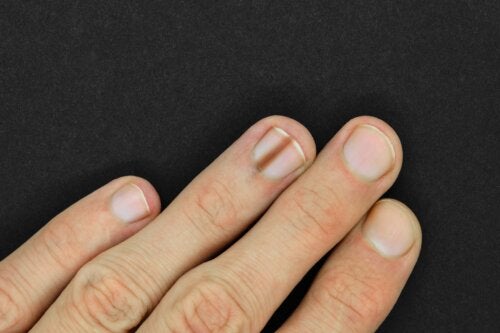
It might appear as a single dark band or stripe on the nail surface. In other cases, it spreads throughout your complete structure, causing discoloration throughout your complete piece. Its appearance is often brown or black. As well as, it might appear on a number of nails.
The symptoms of nail melanonychia
The fundamental clinical manifestation of nail melanonychia is the looks of a brown, black, or grayish longitudinal band. This normally starts on the matrix, but extends towards the tip of the nail plate. In rare cases, it involves your complete nail or originates as a transverse band.
Based on information from Dermatology Research and Practice, the dark coloration is resulting from a rise within the number and performance of melanocytes. The latter are the cells accountable for synthesizing melanin.
When the colour is gray, the cause is hyperpigmentation of the epithelium.
It’s possible that the nail also presents several colours and that the lines that make up the nail melanonychia are wide. As well as, if the cause is a malignant tumor, other serious symptoms could also be present, reminiscent of the next:
- Nodules
- Ulcerations
- Nail dystrophy
- Involvement of the encompassing skin
- Pain (in rare cases)
Forms of nail melanonychia
Depending on the discoloration of the nail, several types of nail melanonychia might be distinguished. Let’s have a look:
- First, we discover longitudinal or striated melanonychia. That is essentially the most common form. On this case, there is barely a protracted, longitudinal band along the nail.
- The second type is diffuse or total melanonychia. What happens is that the discoloration affects your complete nail plate.
- Finally, it might be transverse. The colour line crosses the nail transversely.
What are its causes?
Nail melanonychia occurs resulting from an increase within the variety of melanocytes or their activity. That’s, it occurs when there’s a better than normal melanin production.
- A rise within the variety of melanocytes within the nail is named ‘melanocytic hyperplasia’. This condition might be benign, but in some cases, it also has characteristics of malignancy.
- When it occurs resulting from increased melanin production, it’s called ‘melanocytic activation’.
Nonetheless, there are numerous pathologies or situations that may result in nail melanonychia. We’ll explain them in the next sections.
Infections
Certain infections, each fungal and bacterial, can result in nail melanonychia. Some fungi are capable of manufacturing melanin, which is incorporated into the nails. It’s more common on the feet, as they’re subjected to more continuous moisture.
Some bacterial infections, typical of individuals with a weakened immune system, result in this. For instance, Pseudomonas infection. It may even be observed in individuals with human immunodeficiency virus.
Injuries and skin conditions
Blows to the hands or nails could cause nail melanonychia. The identical is true for varied skin diseases. This pathology has been described within the context of psoriasis, lichen planus, or amyloidosis.
We predict you could also wish to read this text: Press-on Nails: What Are They, and What Are Their Benefits and Disadvantages?
Systemic diseases and pregnancy
Certain diseases, reminiscent of Addison’s disease or Cushing’s syndrome, can result in this condition. The identical is true for some vitamin deficiencies, reminiscent of vitamin B12 deficiency. Malnutrition has also been linked.
Even though it isn’t a disease, pregnancy has been found to be a time when the incidence of nail melanonychia increases. In reality, on this case, it’s common for several different toes to be affected.
Medications
Some drugs, especially those used for chemotherapy, could cause melanonychia. That is one of the crucial common causes of transverse nail banding.
Tumors
Each benign and malignant tumors could cause nail melanonychia. For instance, squamous cell carcinoma is one form of cancer that could cause it. The identical is true for acral lentiginous melanoma. It is a rare, infrequent form of melanoma that affects the nails.
Lentigo is one other associated benign condition, as is nail matrix nevus. The latter is essentially the most common reason behind melanonychia in children. It’s characterised by the presence of ‘nests’ of melanocytes. That’s, by accumulations of melanocytes on the affected site.
Risk aspects
Nail melanonychia can occur in people of all ages and races. Nonetheless, it affects African-Americans and Japanese more ceaselessly. A lot in order that its incidence is estimated to be greater than 75% in African Americans and as high as 20% in Asians.
Nonetheless, this condition is rare in Caucasians. The skin types most affected, in line with Fitzpatrick’s classification, are V and VI.
Moreover, age can be considered a risk factor; it’s particularly seen in people over 50 years of age.
Other associated aspects need to do with the work environment. Individuals who work in continuous contact with water or wet substances usually tend to develop nail melanonychia resulting from infections.
The identical applies to frequent exposure to trauma. Whether at work, during certain sports activities, or some other motion, shocks can result in melanonychia.
The diagnosis and treatment of nail melanonychia
Diagnosis of nail melanonychia might be complex. In some cases, it’s sufficient to research the clinical picture and have an obvious trigger, reminiscent of a blow. Nonetheless, in lots of other patients, it’s obligatory to resort to complementary tests to realize a definitive diagnosis.
Probably the most commonly used test is a biopsy. It consists of extracting a sample of the affected nail and analyzing it within the laboratory. The target is to rule out whether it is a malignant pathology reminiscent of melanoma. It’s essential to perform it in cases of sudden onset or a history of melanoma.
The treatment of nail melanonychia will depend upon its cause. If it’s a benign process, it is probably going that no intervention will likely be obligatory. Nonetheless, if it’s malignant, surgery could also be suggested. The surgery could also be based on removing the nail and even the finger.
Like this text? Chances are you’ll also wish to read: Tips on how to Strengthen Your Fingernails Naturally: 5 Suggestions
What it’s best to remember
Nail melanonychia is a pathology that consists of abnormal and dark pigmentation of a number of nails. This condition might be resulting from multiple causes, each benign and malignant. For instance, it could be a symptom of melanoma.
It’s due to this fact essential to all the time seek the advice of a physician within the event of this sign. Early diagnosis can significantly improve the prognosis by allowing early treatment.
It would interest you…
